From November to December 2021, RxVantage engaged Clarivate, a global leader in providing trusted insights and analytics to the healthcare industry, to survey and conduct in-depth interviews across a sample of physicians, practice managers, and billers and coders. The purpose of the research was to better understand the challenges these distinct roles face in delivering care to patients and uncover opportunities where life sciences can best support these teams and their patients. The practices were inclusive of six specialities: oncology, dermatology, rheumatology, gastroenterology, neurology, and endocrinology.
The research found the number one priority across roles within the practice is patient satisfaction, while the rising cost of healthcare is seen as their greatest challenge. As the consumerization of the patient experience accelerates, care team members are aware of the impact it has on their practice. At the same time, providers and their staff remain highly concerned about the rising costs of healthcare, primarily as it relates to their patients, but also as a threat to the viability of their practice
With these two macro trends as background, how can life sciences companies work to better understand practices’ preferences and support the entire team delivering care? Let’s dive into three key takeaways from the research.
1. Understand practice preferences to develop strategic, impactful strategies
Life sciences companies have the opportunity to better understand preferences and meet the needs of the entire team delivering care to patients, not just physicians. Our research explored the preferences of three distinct functional areas within practices to learn about the requirements of the broader team supporting patients: physicians, practice managers, billers and coders.
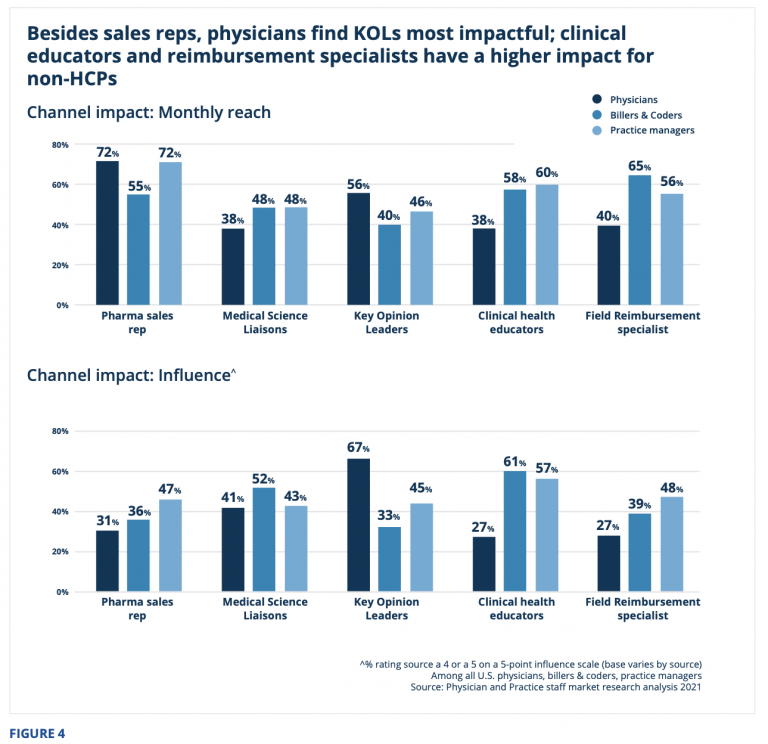
While each care team member reported meeting frequently with various specialists from life sciences companies, the type of specialist most in-demand varies by role. For example, though physicians meet regularly with all specialists from life sciences companies, they find discussions with key opinion leaders (KOLs) most impactful (56 percent). Practice Managers also meet regularly with all life sciences specialists and report their interactions with clinical health educators (57 percent), field reimbursement specialists (48 percent), and pharma sales reps (47 percent) to be most useful (Figure 4). Billers and coders report similar preferences as practice managers.
Key Takeaway:
Life sciences has long focused on “right message, right channel, right time,” but often these efforts aren’t optimized for each member of the care team. Knowing these preferences at the individual level will help life sciences develop more impactful strategies that better support the unique needs of each practice team member. One step you can take to ensure care teams can connect with the specialist they need is to ensure that your full team of specialists (sales, MSLs, reimbursement, etc.) are represented accurately to practices in the RxVantage online Expert Directory.
2. There is a strong interest in accessing life sciences resources on-demand
Regarding practices’ preferences for interacting with life sciences specialists; the research revealed that physicians, practice managers, and billers and coders are interested in different types of resources for their practice and patients. In Figure 5, you will see that the demand for life sciences resources varies among audiences.
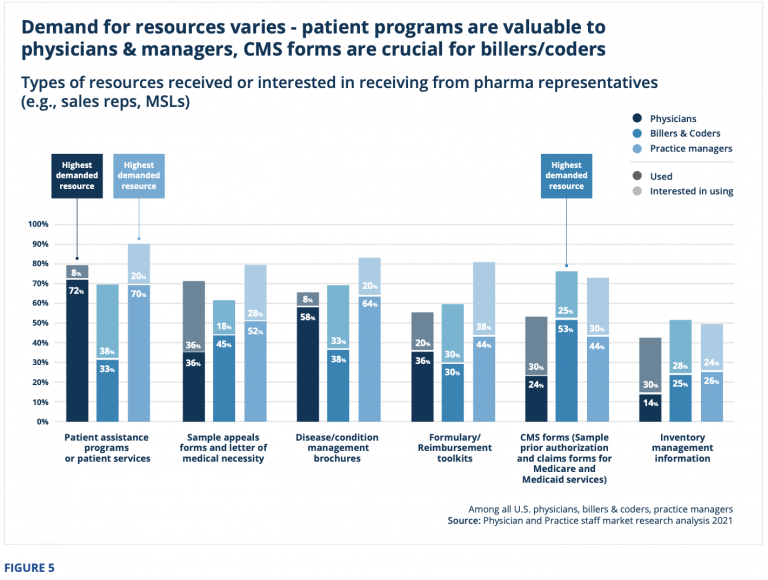
With the broader concern about the rising costs of healthcare, it is no surprise that information around patient assistance programs or patient services is most highly demanded by physicians (72 percent) and practice managers (70 percent). In fact, there is significant unmet need in this area for practice managers, with 90 percent interested in using more of these tools. Disease and condition management brochures are also highly demanded by these audiences when they are interacting with patients. Interestingly, billers and coders report utilizing both patient assistance (33 percent) and disease condition (38 percent) resources the least of these groups. But, interest in using them is very high (71 percent for each category).
Key Takeaway:
Each care team member has different resource needs, but they each seek to have access to the full gamut of resources rather than the resources that align to their perceived role. Physicians not only need disease education, product information and research, but are also interested in patient assistance and other tools related to operations and financial support. The same logic applies to practice managers and billers and coders. These team members want to see the whole picture in order to provide the best care to patients and address their top priorities. With RxVantage, life sciences companies have the ability to make any resource available to any care team member on-demand, including patient assistance program information, patient education materials, reimbursement toolkits, and more.
3. A high level of adaptability will best serve all specialities and workflows
Physicians (62 percent), practice managers (68 percent), and billers and coders (63 percent) all report using digital platforms more often than print for ongoing education about products, reimbursement topics, etc. The list below reveals some of the reasons why physicians, practice managers, and billers and coders would want to use pharma-provided digital tools across their specialities and workflows.
- Improvement in overall efficiency of practice
- Improvement in quality of care provided
- Better accessibility of healthcare
- Reduction in manual effort
- Improvement in timeliness of care
- Optimized primary care systems
Although life sciences companies make many tools and resources available via HCP and
patient-focused websites, apps, and even within EMRs, the research reveals there are still unmet digital resource needs among all care team members. For example, while 37 percent of research respondents reported accessing disease education for patients via life sciences websites, an additional 31 percent are interested in accessing and using these types of digital tools. The largest gap reported was in medication adherence tools where just 22 percent of respondents reported accessing such tools while an additional 43 percent are interested in accessing and using these tools for their patients.
Key Takeaway:
As life sciences companies consider how to best support the practices and elevate the experience for care team members and their patients, innovative and easy-to-use digital tools represent a large opportunity. Many of these tools and resources have already been invested in, created by life sciences, and housed on brand websites, yet access and use remains an obstacle. With practices already overburdened and laser-focused on delivering the best care and addressing rising healthcare costs, life sciences can elevate the experience for care team members and support their goals by simplifying access to their high quality digital tools and resources. RxVantage can help support this process in a myriad of ways, but most importantly, by enabling highly engaged medical practices team members to connect directly to any life sciences expert or resource they need all in one place.
Our white paper research reveals a number of opportunities for life sciences organizations to better serve the needs of the entire team delivering care to patients. Understanding their individual preferences, aligning resources to their specific needs, and being highly adaptive are some of the ways life sciences can better serve care teams. In-person connections are still the most effective way to drive the customer experience, but there is an opportunity to further strengthen the experience by delivering effective digital tools that complement your team of experts. As customer preferences shift, it is important that life sciences organizations have the ability to pivot with them in order to improve patient outcomes.
To gain more insights from this white paper, download your free copy and start reading.
What is RxVantage?
Watch our 3(ish)-minute demo to see how RxVantage connects practices to the industry resources they need to stay on the cutting edge.